
 EN
 ES
 FR
 PT
 IT
 PL
 DE
 TL
 USD $
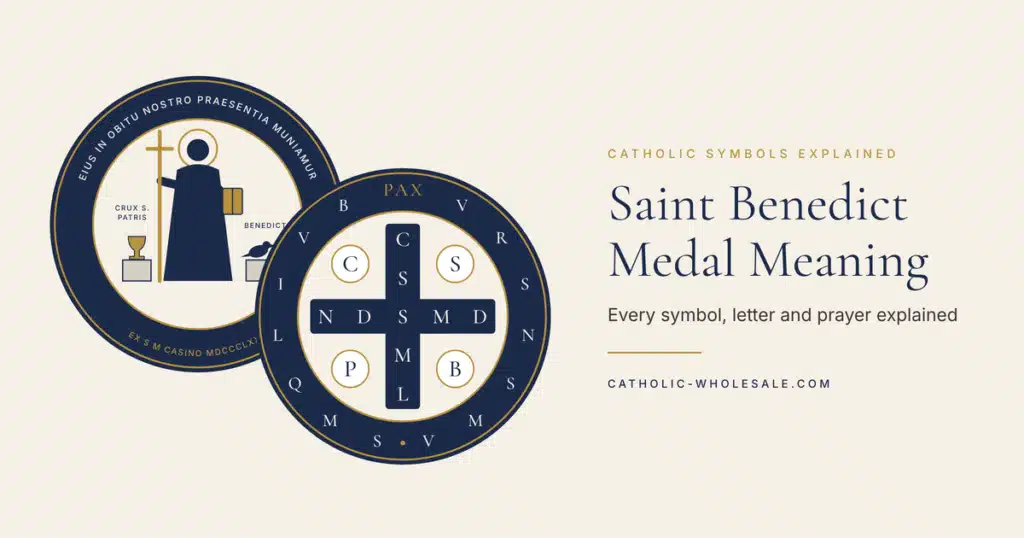
The Saint Benedict medal is a Catholic sacramental: a blessed medal with an image of Saint Benedict on the front and, on the back, a cross surrounded by the initial letters of a Latin prayer against evil. Catholics wear it, or keep it at home, as a prayer for God’s protection through the intercession of Saint Benedict.
St Benedict medal meaning at a glance
- Front: Saint Benedict holding a cross and his Rule, with a poisoned cup and a raven beside him.
- Back: the cross of Saint Benedict with the letters C S P B, C S S M L and N D S M D, and the word PAX above it.
- Around the back: V R S N S M V – S M Q L I V B, the initials of the Vade retro Satana prayer.
- Design used today: the Jubilee medal, struck in 1880 for the jubilee of the saint’s birth.
- Use: blessed by a priest or deacon, then worn, carried, or placed in a home or car.
What is the Saint Benedict medal?
The medal of St Benedict, also called the Benedictine medal, the St Benedict medallion, or the medal-cross of Saint Benedict, is one of the oldest and most honored medals in the Catholic Church, known and worn throughout the Christian world. It is not a lucky charm, and its true meaning has nothing to do with luck. It is a sacramental, which the Catechism of the Catholic Church describes as a sacred sign that prepares a person to receive grace through the prayer of the Church.
Every symbol in the design is a short lesson in the Christian faith. The front shows who Saint Benedict was. The back is a prayer: a large cross, and around it the initials of a Latin text that rejects evil and asks that the cross of Jesus Christ be the wearer’s light. That prayer is why St Benedict medals are associated above all with spiritual protection, and why some Catholics simply call the medal the St Benedict cross.
Who was Saint Benedict?
Saint Benedict of Nursia was born around the year 480 in central Italy. Sent to Rome to study, he left the city as a young man to seek God, and lived for three years as a hermit in a cave at Subiaco. Other monks gathered around him, and in time he founded the abbey of Monte Cassino, where he wrote the Rule of Saint Benedict: seventy-three short chapters on prayer, work, and life in community. He died there on March 21, 547. By tradition, Saint Scholastica, who is honored as the mother of Benedictine nuns, was his twin sister. Almost everything known of his life comes from the second book of the Dialogues of Pope St Gregory the Great, as the Catholic Encyclopedia notes.
Because Western monasteries followed his Rule for centuries, this monk from Nursia is called the father of Western monasticism. The Benedictine motto ora et labora, “pray and work,” is a later summary of his Rule and not a quotation from it. The other Benedictine watchword, “peace,” appears on the medal itself.
What is St Benedict the patron saint of?
Few saints have a longer list of patronages. Pope Paul VI proclaimed Saint Benedict patron of Europe on October 24, 1964, a point Pope Benedict XVI returned to in his 2008 General Audience on the saint. He is also the patron saint of monks, of students and schoolchildren, of farmers, and of the dying. By long tradition he is invoked against poison, fever, kidney disease, and temptation. His feast day is July 11 in the general calendar of the Church; Benedictines also keep March 21, the day of his death.
The front of the St Benedict medal
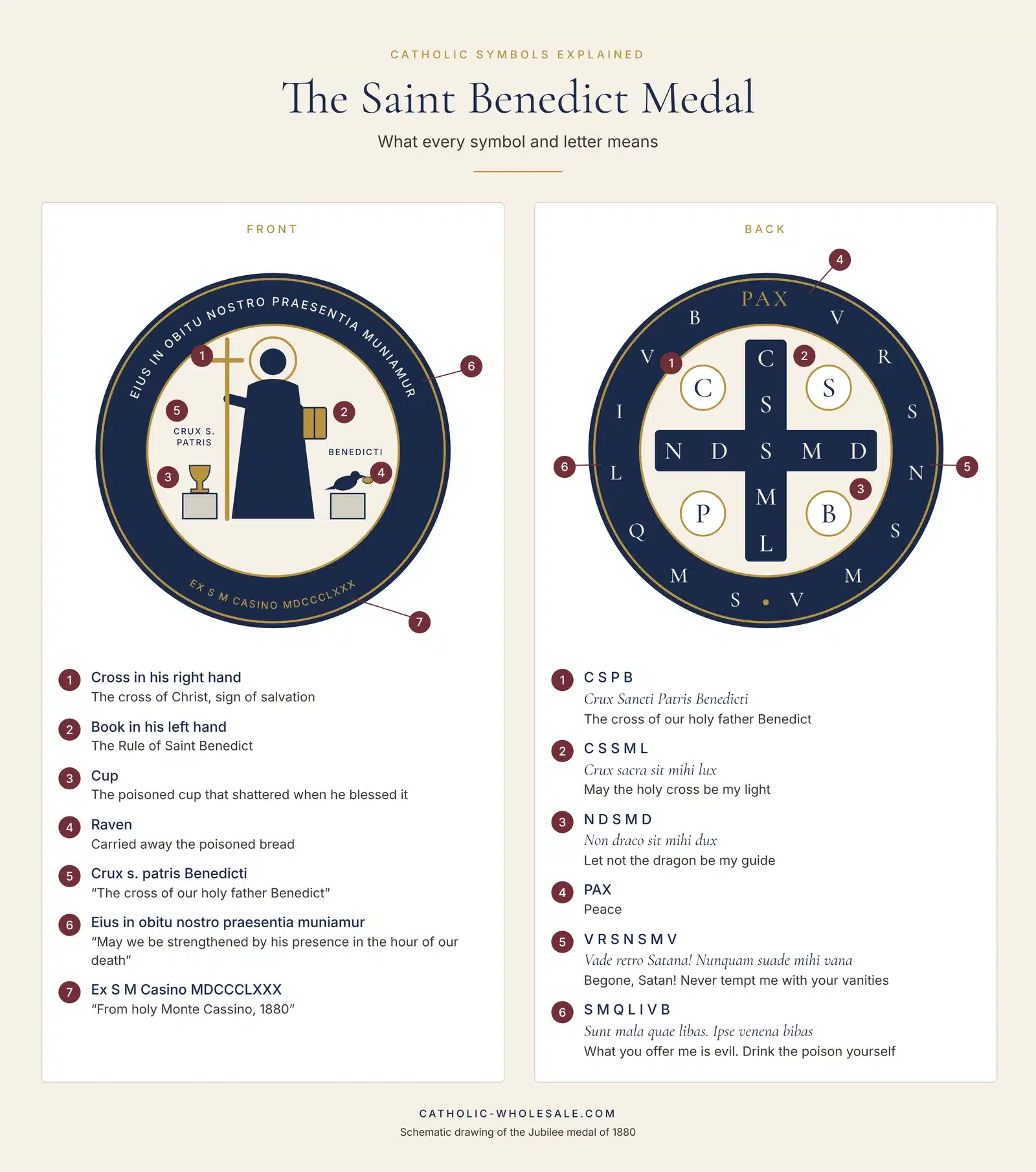
The front of the Jubilee medal carries the image of Saint Benedict standing in his monastic habit. What each symbol means is set out below, following the description published by the Order of Saint Benedict.
| Detail | What it means |
|---|---|
| Cross in his right hand | Held up in his right hand: the cross of Christ, the Christian sign of salvation. |
| Book in his left hand | His Rule for Monasteries. |
| Cup on a pedestal, to his right | The poisoned cup that shattered when he blessed it. |
| Raven, to his left | The bird that carried away a loaf of poisoned bread. |
| Words above the cup and the raven | Crux s. patris Benedicti: “The cross of our holy father Benedict.” |
| Words around the edge | Eius in obitu nostro praesentia muniamur: “May we be strengthened by his presence in the hour of our death.” |
| Words beneath his feet | Ex S M Casino MDCCCLXXX: “From holy Monte Cassino, 1880.” |
The poisoned cup and the raven
Both images come from St Gregory’s account of the saint’s life, and they are the two stories most associated with him. Some monks who had asked Benedict to be their abbot found his discipline too strict and mixed poison into his wine. When he blessed the cup with the sign of the cross, it shattered. Some time later a jealous priest sent him a loaf of bread as a gift, and the bread was poisoned. Benedict told the raven that came to him each day for food to take the loaf away to a place where it could never be found, and the bird obeyed.
These two stories are the reason Saint Benedict is invoked against poisoning, and they explain the last line of the prayer on the back of the medal.
A prayer for a happy death
The words around the edge ask the saint to be near us when we die. According to St Gregory, Benedict died standing in the chapel of his monastery, his arms raised to God in prayer and supported by his monks, shortly after receiving the Body and Blood of the Lord. For that reason Christian tradition honors him as a special patron of a happy death.
The back of the medal: the cross and the letters
The reverse side of the medal is where most questions begin. It is filled by a large cross, and every letter on it is the first letter of a Latin word. For a long time the meaning of these initials was forgotten; it was recovered only in the seventeenth century, as the history below explains.
| Initials | Where they are | Latin | English |
|---|---|---|---|
| C S P B | In the four angles of the cross | Crux Sancti Patris Benedicti | The cross of our holy father Benedict |
| C S S M L | On the vertical bar of the cross | Crux sacra sit mihi lux | May the holy cross be my light |
| N D S M D | On the horizontal bar of the cross | Non draco sit mihi dux | Let not the dragon be my guide |
| PAX | Above the cross | (Latin) | Peace, the Benedictine motto |
| V R S N S M V | Around the edge, starting at the top right | Vade retro Satana! Nunquam suade mihi vana | Begone, Satan! Never tempt me with your vanities |
| S M Q L I V B | Around the edge, continuing | Sunt mala quae libas. Ipse venena bibas | What you offer me is evil. Drink the poison yourself |
“The dragon” is an old name for the devil, taken from the Book of Revelation. Read together, the two lines on the cross are a single act of faith in Jesus Christ.
Vade retro Satana: the St Benedict medal prayer
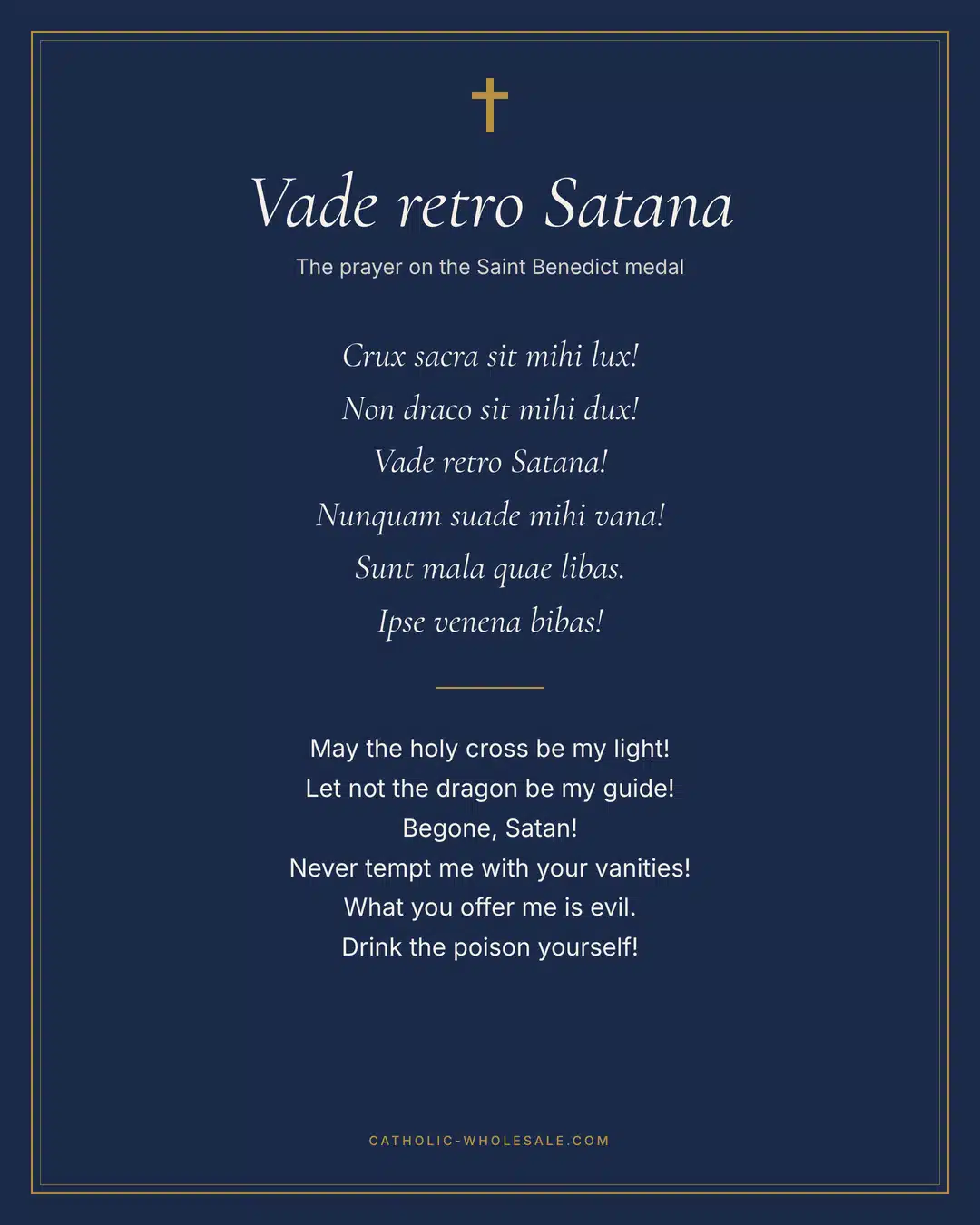
The letters that circle the back of the medal stand for the Saint Benedict prayer itself: a short Latin text in verse, usually called the Vade retro Satana:
Crux sacra sit mihi lux! Non draco sit mihi dux! Vade retro Satana! Nunquam suade mihi vana! Sunt mala quae libas. Ipse venena bibas!
In English:
May the holy cross be my light! Let not the dragon be my guide! Begone, Satan! Never tempt me with your vanities! What you offer me is evil. Drink the poison yourself!
The words Vade retro Satana echo the rebuke of Our Lord in the Gospels: “Get behind me, Satan.” Because the text commands evil to depart, it is sometimes called the St Benedict exorcism prayer. It is not the Church’s rite of exorcism, which only a priest appointed by a bishop may perform. It is one of the short daily prayers any Christian can say: in a time of temptation, before a hard decision, or at the start of the day.
A short prayer to St Benedict for protection
Many Catholics add a few words of their own when they put the medal on. A simple prayer to say from the heart:
Saint Benedict, man of God and friend of Christ, pray for me. Ask the Lord to be my light today. By your intercession may I be kept from evil and from every temptation, and have the grace of a holy death. Amen.
Where the medal comes from: a short history
No one knows exactly when the first medal of Saint Benedict was struck. Its history can be followed through a handful of dates.
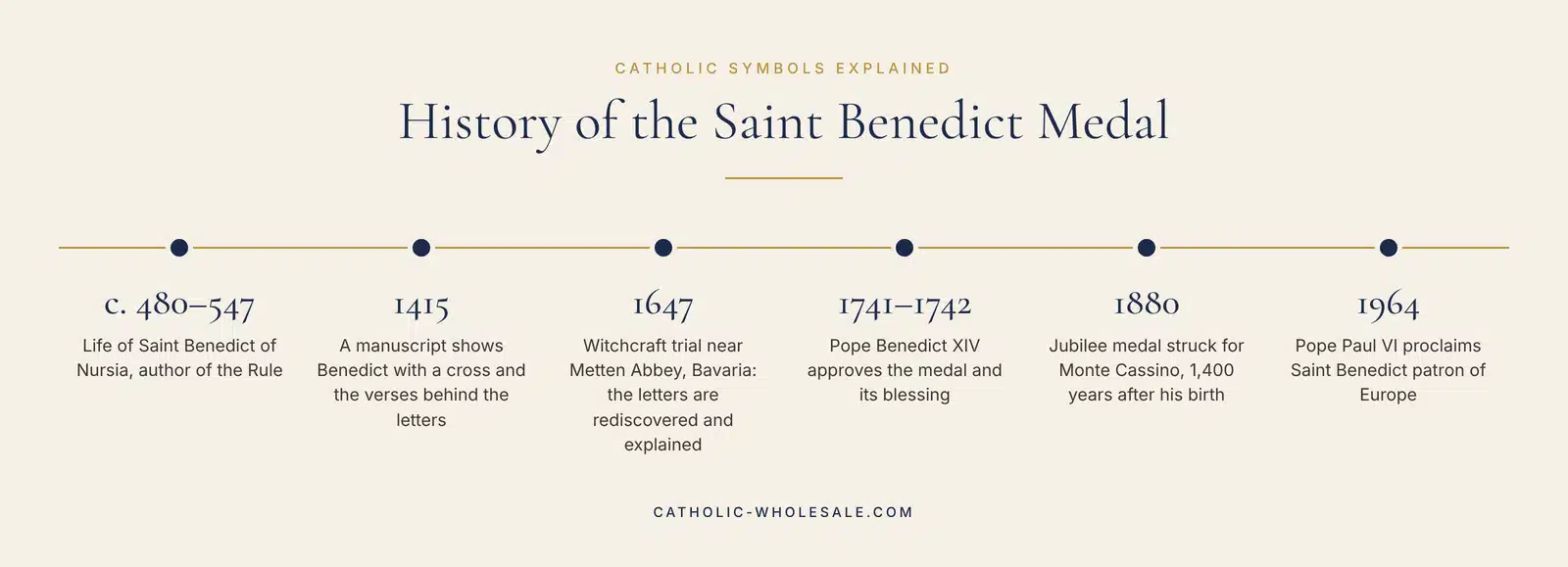
- About 480–547. The life of Saint Benedict. Devotion to the cross of Christ, and to Benedict as a great defender against evil, grows in the religious houses that follow his Rule.
- 1415. A manuscript written in this year shows Saint Benedict holding a staff that ends in a cross, together with the verses whose initial letters appear on the medal.
- 1647. During a witchcraft trial at Natternberg in Bavaria, the accused women testify that they had no power over nearby Metten Abbey, because it was under the protection of the cross. A search of the abbey finds crosses painted on the walls with the mysterious letters, and then, in the library, the manuscript of 1415 is found, which explains them. Medals bearing the letters spread quickly from Bavaria.
- 17th century. Saint Vincent de Paul’s Daughters of Charity wear the medal on their rosary beads.
- 1741 and 1742. Pope Benedict XIV approves the medal and its blessing, as the Catholic Encyclopedia records.
- 1880. For the 1,400th anniversary of Benedict’s birth, a new medal is struck under the supervision of the monks of Monte Cassino. Designed by the Benedictine monk and artist Desiderius Lenz of Beuron Archabbey in Germany, this Jubilee medal is the one most widely made and worn in the world today.
What does the St Benedict medal protect you from?
The medal is first of all a prayer for God’s help against evil and temptation. Older devotional books add a longer list of intentions: protection against poison, against witchcraft and every influence of the devil, against storms and contagious disease, and help for the sick, for mothers at the time of birth, and especially for the dying.
None of this works by itself. The Order of Saint Benedict puts it plainly: religious articles are not charms and have no magic power to bring luck or health. The Church teaches that sacramentals draw their effect from the prayer of the Church and from the faith of the person who uses them. The true power behind the medal is not the metal but God, who answers the prayers of his saints and of his Church. A St Benedict medal gives spiritual protection in the way a prayer does: it places the wearer, again and again, under the cross of Christ and asks for Saint Benedict’s intercession.
How is the St Benedict medal blessed?
A medal becomes a sacramental when it is blessed. The Church has a special blessing for St Benedict medals, in which the priest says prayers of exorcism over the medals, asks God to bless them, and sprinkles them with holy water.
- Who can bless it? Any priest or deacon; he does not have to be a Benedictine. Simply take the medal to your parish and ask.
- Can I bless it myself? No. A layperson can pray with an unblessed medal, but the blessing belongs to the Church’s ordained ministers.
- Is there an indulgence? Under the Church’s general norm, a person who devoutly uses a properly blessed article of devotion, such as a medal, a crucifix, or a rosary, can gain a partial indulgence.
How to wear and use the medal
There is no special way prescribed for carrying or wearing the medal. Catholics have many customs:
- Wearing it as a necklace, on a chain or cord, or on a bracelet at the wrist.
- Attaching it to a rosary. Many rosaries are made with a St Benedict medal as the center piece.
- Keeping it in a pocket, wallet, or purse.
- Placing it in the car.
- Hanging it in the home, especially above or beside the main door.
- Setting it into the foundations of a new house, or fixing it to the walls of barns, sheds, and workplaces.
Whatever the custom, the medal is meant to prompt prayers, not to replace them.
Lay Oblates of Saint Benedict may wear the medal in place of the small cloth scapular of their order.
Which side faces out? The Church gives no rule. Many Catholics wear the cross side outward, so that the prayer is visible, while others prefer the image of the saint. Either is fine.
What if the medal breaks or is lost? Nothing bad follows from it; that idea is superstition. A blessed, sacred object that can no longer be used is traditionally buried or burned, not thrown away, and a new medal can be blessed.
St Benedict cross, crucifix, bracelet, and rosary
The same medal appears in several forms, and the names can be confusing.
- St Benedict cross. Also called the Benedictine cross: a name for the cross on the back of the medal, and for the medal itself.
- St Benedict crucifix. A crucifix with the medal set into its center, behind the figure of Christ. It joins the image of the Crucified to the prayer of the medal, which is why it is often chosen as the crucifix for a home.
- St Benedict bracelet. A cord or bead bracelet that carries one or more medals. The St Benedict bracelet meaning is the same as that of the medal: it keeps the prayer on the wrist in daily life. Our Saint Benedict bracelet is handwoven in Bosnia and Herzegovina with medals made in Italy, and there is a St Benedict crucifix bracelet and a St Benedict bracelet for kids, a frequent First Communion gift, in the same family.
- St Benedict rosary. A rosary whose center piece or crucifix carries the medal, such as our Saint Benedict Rosary.
- Loose St Benedict medals. Shops and makers of rosaries who set their own pieces can order the St Benedict Medal separately.
Parish shops and gift stores can see the whole range in our St Benedict bracelets collection. Our medals are not blessed when they leave the workshop; that is for your priest or deacon to do.
St Benedict medal or Miraculous Medal?
They are different devotions. The Miraculous Medal comes from the apparitions of Our Lady to Saint Catherine Labouré in Paris in 1830 and is a prayer to Mary. The Saint Benedict medal is centuries older and is a prayer for protection under the cross. Many Catholics wear both close to the heart, and the two are often paired in one piece; see our Miraculous medal bracelet. Those who look for a patron against evil also turn to Saint Michael the Archangel, as on the St Michael Bracelet.
Frequently asked questions
What does the St Benedict medal mean?
The St Benedict medal meaning in one line: it is a prayer in metal. One side honors Saint Benedict and asks him to be near us at the hour of death. The other side shows the cross of Jesus Christ and the initials of a Latin prayer that rejects Satan and the empty things he promises.
What do the letters on the back of the St Benedict medal mean?
C S P B stands for Crux Sancti Patris Benedicti, “The cross of our holy father Benedict.” The letters on the cross itself, C S S M L and N D S M D, ask that the cross be our light and that the devil never be our guide. The fourteen letters around the edge are the initials of the prayer that tells Satan to be gone.
Does a St Benedict medal have to be blessed?
To be a sacramental, yes. Any priest or deacon can bless it, using the Church’s blessing for the medal of Saint Benedict.
Can anyone wear a St Benedict medal?
Yes. It is a Catholic sacramental, but nothing forbids other Christians from wearing it. What matters is that it is worn as a prayer and not as a charm.
What is the St Benedict prayer for protection?
The prayer on the medal itself, given in full above. It can be prayed in Latin or in English, and many Catholics say it each morning when they put on the medal.
Where should I put a St Benedict medal in my home?
Wherever it will remind you to pray. The most common custom is above or beside the main door; others keep a St Benedict crucifix on a wall or a medal in each room.
When is the feast day of Saint Benedict?
July 11 in the general Roman calendar. Benedictine communities also celebrate March 21, the anniversary of his death in 547.
Sources and further reading
- Order of Saint Benedict, The Medal of Saint Benedict
- Catholic Encyclopedia, Medal of Saint Benedict and St. Benedict of Nursia
- Benedict XVI, General Audience of April 9, 2008: Saint Benedict of Norcia
- Catechism of the Catholic Church, Sacramentals (1667–1679)
- Wikipedia, Saint Benedict Medal and Benedict of Nursia